
Most People Don’t Know Where Failure Actually Is
I saw an article from the ACSM recently talking about training with reps in reserve instead of constantly training to failure.
And honestly, I don’t disagree with the general idea.
I don’t think every set needs to be taken to failure. I don’t think every lift needs to be treated like a death match. I don’t think most people, especially those of us training after 40, need to bury ourselves under unnecessary fatigue just to prove that we’re working hard.
There is a lot of value in leaving a rep or two in the tank.
It can help keep technique cleaner. It can help manage fatigue. It can make training more repeatable from set to set and week to week. It can let you train hard without turning every workout into something you have to recover from for the next three days.
So when someone says, “You don’t need to train to failure all the time,” I’m not pushing back against that.
I agree.
Where I do push back is with the assumption that most people actually know where failure is.
That’s the part I think gets skipped over too often.
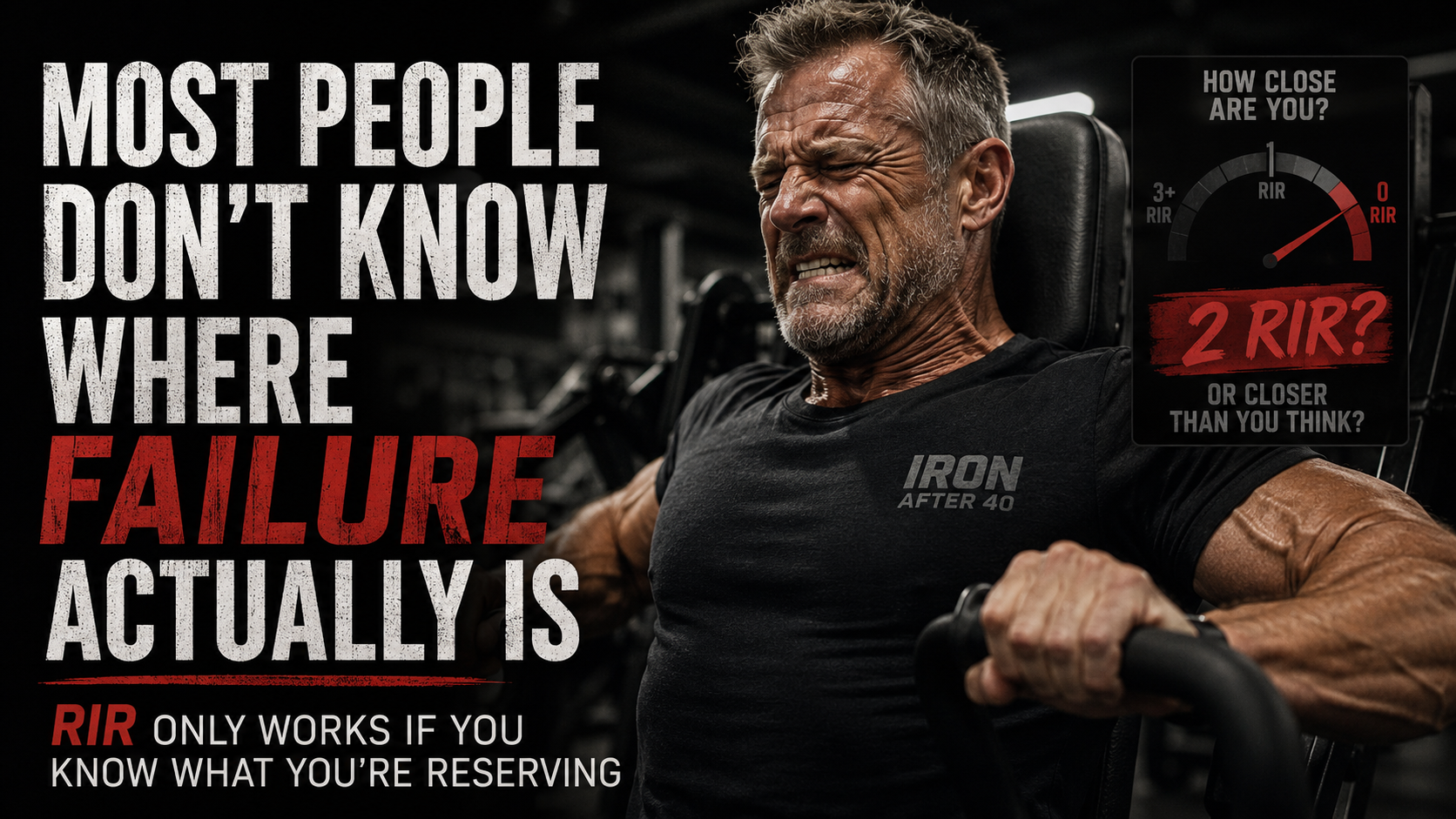
Because saying “leave two reps in reserve” sounds simple. It sounds clean. It sounds measurable. But it only works if you actually understand what your true failure point looks like on that exercise.
And I don’t think most people do.
Most lifters are not stopping two reps shy of failure. A lot of them are stopping two reps shy of discomfort. They hit the point where the set starts to burn, the reps slow down, the weight feels heavy, or their mind starts looking for the exit, and they call that one or two reps in reserve.
But that may not be true.
Sometimes that’s five reps in reserve.
Sometimes it’s six.
Sometimes it’s more.
That’s a problem if the goal is building muscle.
Because if you’re basing your entire training effort on reps in reserve, but your internal gauge is wrong, then the whole system gets thrown off. You may think you’re training with two reps left in the tank, when in reality you’re nowhere near the level of effort needed to create the stimulus you’re looking for.
That’s where people end up doing a lot of work without getting much back from it.
They have the program. They have the exercises. They have the rep ranges. They have the logbook. They may even be using the right language. RIR. Progressive overload. Proximity to failure. Fatigue management.
But the actual set is not hard enough.
That matters.
There is a difference between a set being uncomfortable and a set being close to failure.
A burning muscle is not automatically failure. A heavy weight is not automatically failure. A slow rep is not automatically failure. Wanting the set to be over is definitely not failure.
Failure is when you are still trying to move the weight with the target muscles and the rep will not complete.
That’s different.
And honestly, it’s uncomfortable to learn. Most people don’t like finding that line because it forces you to realize how early you may have been stopping.
I’ve had that realization myself.
There were years where I thought I was training hard because my workouts were long, my weights were heavy enough to feel serious, and I was leaving the gym tired. But tired and productive are not always the same thing. Looking back, I was probably doing too much total work while also leaving too many real reps on the table.
That’s not a great combination.
You accumulate fatigue, but the actual stimulus from each set is not as high as it should be.
That’s where better training starts to matter more than just more training.
This does not mean you need to take every set to failure. That’s not what I’m saying. In fact, I think that would be a mistake for most people, especially on big compound lifts or movements that carry a higher cost when form breaks down.
A squat taken to true failure is not the same thing as a cable curl taken to true failure. A heavy barbell press taken to failure is not the same thing as a machine lateral raise. The risk, fatigue cost, and recovery demand are not the same.
So no, I’m not saying every set should become an all-out grinder.
What I am saying is that you need to have some understanding of where failure actually is so your “reps in reserve” means something.
You have to calibrate it.
That might mean, occasionally, on safer exercises, you take a set all the way to the point where another clean rep is not there. Not every exercise. Not every week if you don’t recover well from it. Not on movements where failure puts you in a bad position.
But on a machine press, leg extension, hamstring curl, cable row, lateral raise, curl, triceps pressdown, or other lower-risk movement, there is value in learning what the end of the set actually feels like.
Because once you know what zero reps in reserve feels like, now one or two reps in reserve becomes a lot more honest.
That’s when RIR becomes useful.
Without that reference point, it’s mostly a guess.
And most people guess in the direction that protects them from discomfort.
That’s human nature.
The body does not want to go there. The mind definitely does not want to go there. Once the set starts getting ugly, your brain gets very good at giving you reasonable-sounding excuses.
That’s enough.
Form is about to break.
You don’t want to overdo it.
Save some for the next set.
You trained hard enough.
Sometimes those thoughts are correct. Sometimes pulling back is the right decision. But sometimes it’s just your brain negotiating with effort.
You have to learn the difference.
That’s one of the biggest skills in training.
After 40, I think this becomes even more important because we do need to manage fatigue. We do need to recover. We do need to be smarter with exercise selection, volume, and how often we push to the edge.
But smarter training does not mean easier training.
It means knowing where the edge is, and choosing when to approach it.
If you never learn where failure is, you can’t really say you’re stopping short of it. You’re just stopping.
That’s the part people don’t like to hear.
Reps in reserve is a good tool. I like the concept. I use the concept. I think it makes sense for a lot of training, especially if you’re trying to build muscle without beating yourself into the ground.
But it depends on honesty.
A true two RIR set should feel like you had about two clean reps left, not like you stopped when things got hard. A true one RIR set should feel like you were right on the edge, not like you simply didn’t want to grind anymore. And a true zero RIR set should teach you something about what your limit actually is.
That doesn’t happen by accident.
You have to pay attention.
You have to learn the difference between discomfort and failure. You have to know when form is breaking down because the target muscle is done, and when form is breaking down because the setup was bad from the start. You have to know which exercises are worth pushing hard and which ones need more restraint.
That’s where experience comes in.
That’s also where a lot of progress gets unlocked.
Because once you understand where failure actually is, you don’t have to chase it all the time. You can train just shy of it with a lot more accuracy. You can manage fatigue without undertraining. You can make fewer sets count for more. You can stop adding volume to compensate for sets that were never as hard as you thought they were.
That’s the balance.
Not training like an idiot.
Not training scared.
Hard enough to create the reason for your body to adapt, but controlled enough to keep you coming back.
So yes, I agree with the idea that you don’t need to train to failure all the time.
But before you build your entire approach around reps in reserve, make sure you actually know what failure feels like.
Because if you don’t know where the line is, it’s very easy to convince yourself you’re training close to it.
— Rob
Coach
Iron After 40