
You Don’t Need to Start Over Every Time Life Interrupts You
It’s been 29 days since I last published an article.
That wasn’t really the plan, but life got loud for a little while. College picked up. My own training has been demanding more from me. I’ve been working through a slew of new client onboarding. Add in the normal responsibilities that don’t pause just because you have goals, and the newsletter got pushed to the side longer than I intended.
I’m not saying that as some dramatic apology. I’m saying it because that’s real life.
And honestly, that’s the exact thing a lot of people deal with when it comes to training, nutrition, and trying to build something after 40. Things are moving along, you feel like you have a decent rhythm, and then life starts pulling from every direction. Work gets busy. School gets demanding. Family needs more from you. Sleep gets weird. Stress goes up. Schedules change. Before long, the plan that felt pretty solid a few weeks ago feels like it’s slipping through your hands.
That’s where a lot of people make the mistake of thinking they need to start over.
They miss a few workouts, so they decide the program is basically ruined. They have a rough week of eating, so they tell themselves they blew the whole phase. They lose their normal routine for a little while, and instead of just getting back into the next useful step, they start looking for a brand new plan.
New program. New diet. New split. New schedule. New reset.
I understand why that happens. Starting over feels clean. It gives you that temporary feeling of control again. It feels like you’re wiping the slate and making a fresh commitment.
But most of the time, you don’t need to start over.
You need to resume.
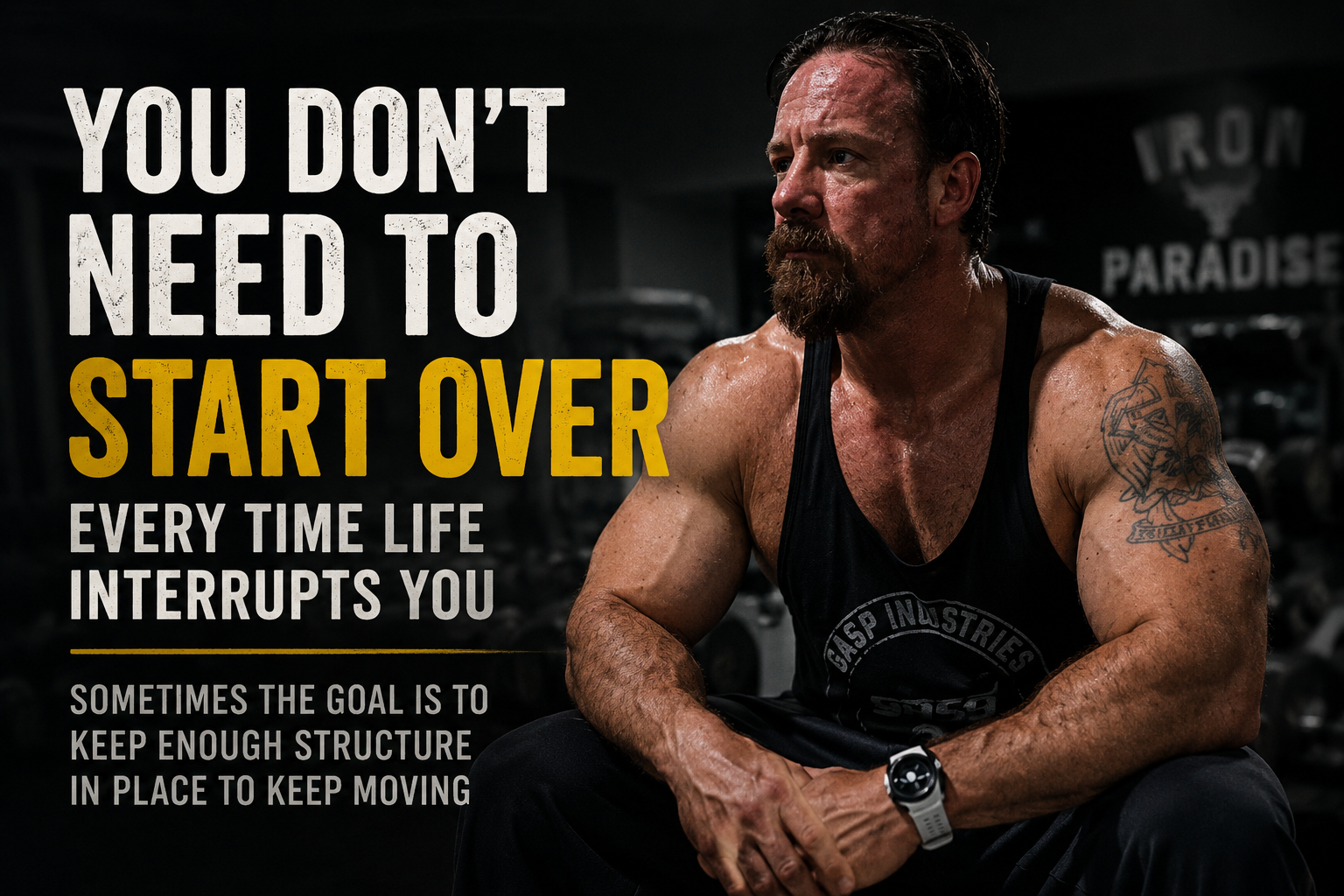
That sounds simple, but it’s a different mindset. Starting over usually comes with frustration, guilt, and the idea that everything you were doing before somehow stopped counting. Resuming says, “Life interrupted me, but the work still matters. I’m picking it back up from here.”
That’s a much better way to look at it.
Because the truth is, if you’re over 40 and trying to stay strong, build muscle, improve your body, or just keep yourself moving in the right direction, life is going to interrupt you. Not once. Not occasionally. Repeatedly.
That doesn’t mean you’re failing. It means you need a plan and a mindset that can survive real life.
A lot of people build their entire approach around perfect conditions. They’re great when the schedule is calm, meals are prepped, sleep is decent, motivation is high, and nothing unexpected is happening. But the second life gets messy, everything falls apart because the plan only worked when nothing challenged it.
That’s not a durable plan.
After 40, I think one of the most important skills you can build is learning how to keep enough structure in place when life is not ideal. Not perfect structure. Not the full version of everything. Just enough.
Enough training to keep the pattern alive. Enough protein to not completely drift. Enough sleep effort to not make things worse than they already are. Enough movement to keep your body from feeling like it’s rusting in place. Enough awareness to know when you’re slipping without turning it into some emotional spiral.
That’s usually what keeps you from needing a full restart.
There are going to be seasons where you can push hard. You can train with more focus, track more tightly, progress more aggressively, and really chase something. Those phases matter.
But there are also going to be seasons where the goal is not to hit some perfect peak of execution. The goal is to not let everything unravel while life is demanding more from you.
That doesn’t mean you lower the standard forever. It means you adjust the standard for the season you’re in.
If your normal plan is five days a week and life only gives you three solid sessions, then hit the three and make them count. If your nutrition usually feels dialed in but this week is chaotic, then maybe the win is getting protein in, keeping meals reasonable, and not turning every busy day into a free-for-all. If sleep is rough, maybe the goal is not some perfect recovery routine. Maybe it’s just getting to bed earlier when you can and not making the problem worse by staying up scrolling for no reason.
That’s not quitting. That’s managing the situation.
There’s a big difference between making an adjustment and letting go of the standard completely.
And I think that’s where a lot of people get stuck. They think if they can’t do the full version, the whole thing doesn’t count. So instead of doing what they can, they do nothing. Then nothing turns into a week. A week turns into a month. A month turns into “I need to get back on track,” and now they’re treating a normal interruption like a total collapse.
Most of the time, it didn’t need to go that far.
You don’t need to be perfect to keep moving. You just need to keep enough of the structure alive that the next step is still obvious.
That’s one of the reasons I always come back to the boring basics. They’re not exciting, but they’re dependable. Train. Eat enough protein. Manage fatigue. Sleep as well as life allows. Don’t let one bad day become a bad week. Don’t let one missed workout turn into a new identity.
The basics are what you fall back on when life gets loud.
And life does get loud.
That’s been my own reminder lately. I don’t like going almost a month without publishing. I don’t like feeling like something important got pushed to the side. But I also know enough now not to turn that into some dramatic reset. The work didn’t disappear. The message didn’t disappear. The standard didn’t disappear.
It just got interrupted.
So now I’m resuming.
That’s the same approach I think most people need with training. Stop treating every interruption like proof that you failed. Stop assuming you need a completely new plan every time life knocks you out of rhythm. Most of the time, the better move is much simpler than that.
Pick up the next workout.
Make the next meal make sense.
Get back to the habits that were already working.
Adjust what needs to be adjusted.
Then keep going.
Not because everything is perfect again, but because it never really needed to be perfect in the first place.
— Rob
Coach
Iron After 40