Your Program Should Have Priorities
You can train everything, but you can’t prioritize everything
One thing I think a lot of lifters struggle with is trying to make everything the priority at the same time. They want bigger arms, thicker chest, wider back, better shoulders, stronger legs, better conditioning, better strength numbers, lower body fat, better recovery, and fewer aches and pains. I understand it because I want a lot of those things too. Most of us don’t walk into the gym wanting only one thing. We want the whole package.
The problem is that training doesn’t usually work that cleanly. You can train everything, but you can’t prioritize everything.
That distinction matters. A balanced program should still cover the whole body. I’m not saying you ignore muscles just because they’re not your main focus right now. But there is a difference between maintaining something, progressing something slowly, and making something the primary target of the entire training phase.
That’s where a lot of people get stuck. They keep trying to bring up every body part at once, so nothing really gets enough focused attention to change. Every muscle gets some work. Every session feels busy. The weekly volume looks impressive on paper. But the actual priority is unclear. And when everything is treated like the priority, nothing really is.
I’ve had to remind myself of this in my own training lately. Right now, my quads are lagging behind where I want them to be. That’s not me being dramatic. It’s just an honest assessment. If I’m serious about building a competitive physique, my legs, specifically my quads, need to come up. That means my training has to reflect that.
I can’t just say my quads are a priority and then keep training chest and back with the same amount of volume, effort, and recovery demand as before. That might feel good because I like training those areas, and they respond well for me, but it doesn’t line up with the goal. So I’ve had to pull back some of the volume on chest and back to make more room for leg training.
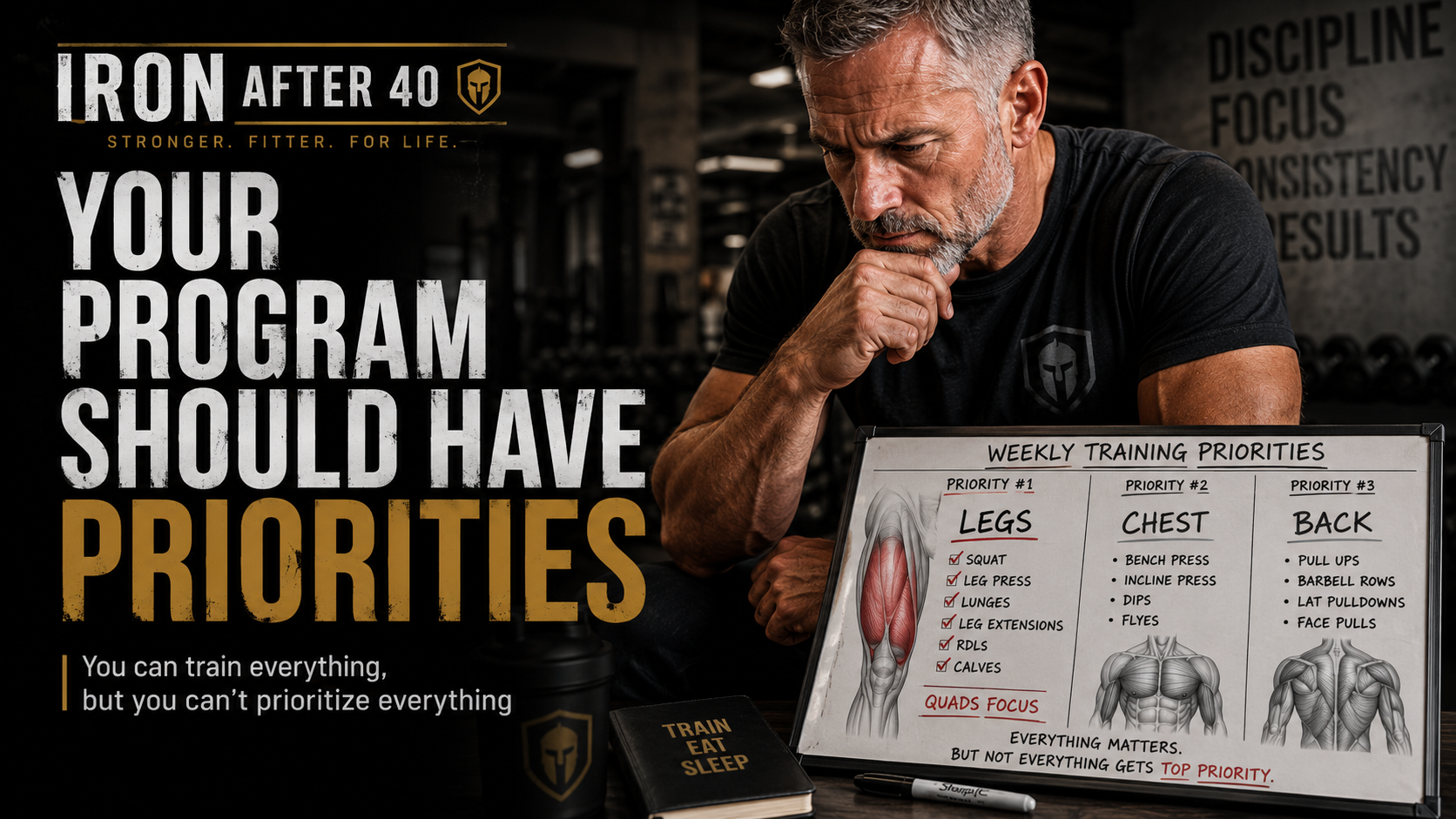
That doesn’t mean I stopped training chest and back. It doesn’t mean I don’t care about those areas anymore. It just means they don’t need to take up as much recovery right now as my quads do. That’s the part people don’t always want to accept. A priority costs something. It costs energy, recovery, attention, and space in the program. Sometimes it means something else has to move to the back seat for a while.
That’s especially true after 40 because recovery is not unlimited. You can’t always just keep adding more and assume your body will sort it out. If you want to bring up a lagging body part, you may need to shift resources toward it instead of simply piling more work on top of everything else.
For me, quads are not easy to prioritize because training them takes a lot out of me. A hard leg session is not the same as adding a few extra sets of curls or lateral raises. When I train quads hard, it carries a real cost. The session takes energy. The soreness can be significant. The recovery time is longer. It affects how I move, how I feel, and sometimes how productive the next few training days can be. That has to be accounted for.
It would be easy to say, “Well, just train quads harder and add more volume.” But that’s not always the answer. If I add more quad work without pulling anything else back, now I’m asking my body to recover from more total work while already targeting a muscle group that takes a lot out of me. That may work for a little while, but eventually the cost shows up somewhere. Performance drops. Joints start complaining. Fatigue starts building. The next workout suffers. Or I’m sore for so long that the next leg session gets pushed back or loses quality.
That’s not productive prioritization. That’s just adding work and hoping it works out.
A better approach is to make the priority clear and adjust the rest of the program around it. If quads are the focus, they need better placement, better energy, better exercise selection, and enough recovery to actually adapt. That might mean they get trained earlier in the week. It might mean the first leg movement is chosen carefully instead of randomly. It might mean I don’t bury them after other work that already drains me. It might mean chest and back stay in the program, but with just enough volume to maintain or progress slowly while the quads get the larger share of attention.
That is not a downgrade. That is programming.
There’s a big difference between training hard and training with direction. A lot of people train hard. They sweat. They push. They get sore. They leave the gym tired. But hard training without priorities can turn into a lot of effort spread too evenly across too many goals. That can keep you busy for years without changing the thing you most want to change.
If your chest is lagging, your program should show that. If your back needs more width, your program should show that. If your shoulders are the weak point, your program should show that. If your legs need to come up, your program should show that. Not just in your intentions, but in the actual structure.
Where does that muscle show up in the week? How much quality work does it get? Are you training it when you’re fresh, or only after everything else has already taken your best effort? Are the exercises chosen because they actually target the weakness, or because they’re familiar? Are you giving that area enough stimulus to grow and enough recovery to come back stronger?
Those questions matter because priorities are not just what you say you care about. Priorities are what your program is built around.
A lot of people say they want to bring up a weak point, but their training doesn’t really support it. They tack on a few extra sets at the end of a workout and call it a priority. They train the weak area after the muscles they already like training. They give it whatever energy is left over and then wonder why it doesn’t change.
That’s not prioritizing it. That’s acknowledging it. Those are different things.
If something truly needs to come up, it probably needs better attention than leftovers. That doesn’t mean you abandon everything else. It means you organize the program so the goal has a real chance. Sometimes that means more volume for the target area. Sometimes it means better volume, not just more. Sometimes it means improving execution. Sometimes it means using exercises that load the muscle better without beating up the joints. Sometimes it means training the muscle more frequently with slightly less work per session so recovery is more manageable.
And sometimes it means pulling back somewhere else. That’s the part people resist, but after 40, that may be the smartest part. You only have so much recovery to spend. If you spend all of it trying to keep every muscle, every lift, and every goal at full priority, you may not have enough left to actually bring up the thing that needs the most work.
That doesn’t mean you’re training less seriously. It means you’re training more intentionally.
Right now, for me, that means understanding that chest and back can afford to take a small step back in volume while I put more focus into my quads. They’re not being neglected. They’re just not the main project right now. The main project is the area that needs the most improvement.
That’s how training phases should work. There are times to build everything broadly. There are times to maintain what is already strong while bringing up what is behind. There are times to push strength. There are times to focus on hypertrophy. There are times to prioritize recovery. There are times to make a specific body part the center of attention. The mistake is trying to make every phase do everything.
Most programs get better when they have a clearer purpose. That purpose doesn’t have to last forever. Priorities can change. Once a weak point improves, you can shift the focus somewhere else. That’s part of the process. Training should evolve based on what your body needs, what your goals require, and what your recovery can actually support.
But for a period of time, the priority needs to be obvious. If someone looked at your training week, they should be able to tell what you’re trying to accomplish. If they can’t, there’s a good chance the program is trying to do too much at once.
That’s something worth looking at in your own training. What is the main thing you’re trying to improve right now? Not the ten things you eventually want. The main thing. Then look at your program and ask whether it actually reflects that.
Because the body responds to what you repeatedly ask it to do, not what you casually hope will happen.
If everything is important, everything gets a little attention. But if one thing truly needs to improve, it may need more than a little attention. It may need to become the priority. And if it becomes the priority, something else probably has to give a little.
That’s not a problem. That’s how you make room for progress.
— Rob
Coach
Iron After 40
P.S. Below you’ll see something a little newer. I’ve spoken about them once or twice, but these are the tried and true, real deal supplements and Peptides that I use. If you’re interested in trying something, you would be supporting us by using our code IRON.