
Supplements Aren’t Required
They can help, but they can’t replace the work
I like supplements, so I want to make that clear from the start. I use them. I enjoy them. I like having a solid pre-workout before a hard session. I like having whey protein available when I need an easy way to hit my protein. I use creatine. I use intra-workout products at times. I have products I genuinely like and brands I genuinely trust.
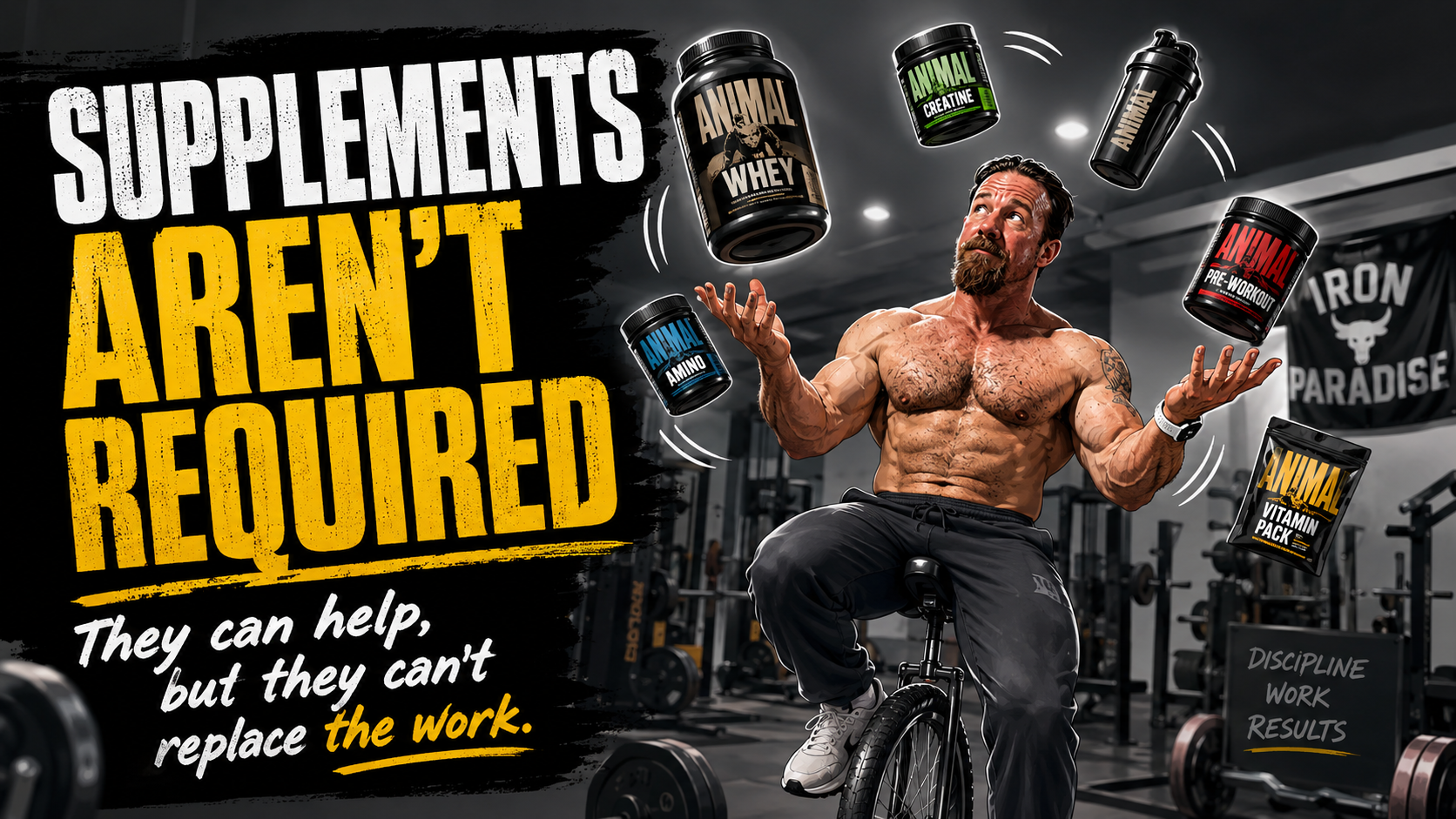
So this is not an anti-supplement article. But I do think a lot of people put supplements in the wrong place.
They start treating them like requirements instead of tools. They start thinking the stack is what makes the difference. They worry more about what they’re taking than what they’re doing. Before long, the supplement cabinet becomes more organized than the actual training and nutrition plan.
That’s where I think people get off track, because supplements can help, but they are not the foundation. The foundation is still training, nutrition, sleep, recovery, consistency, effort, progression, and time. That’s the stuff that actually builds the body.
Protein powder does not replace eating enough protein throughout the day. It can help you get there, but it is not magic. If you’re constantly missing meals, eating too little, or not paying attention to total intake, a shake is not going to solve the bigger problem.
Creatine can be useful. It’s one of the few supplements I think makes sense for almost everyone who trains seriously. But creatine does not make up for lazy workouts. It does not fix bad exercise selection. It does not replace progressive overload. It supports the process, but it does not create the process.
Pre-workout can be helpful too. Some days, a good pre-workout makes a difference. It helps you get moving, focus a little better, and bring more energy to the session. I get that because I use it myself. But pre-workout should not become the only reason you can train hard.
If the only way you can have a productive session is by loading yourself with stimulants, then the issue may not be the supplement. The issue may be sleep, recovery, stress, nutrition, or the fact that you’re trying to force output from a body that is already running on fumes. That matters more after 40 because at this stage, you can’t just cover up poor recovery with more caffeine forever and expect it not to catch up with you. You might get through the workout, but that doesn’t mean the system underneath is working well.
That’s the distinction I keep coming back to. Supplements should support a solid plan. They should not be used to hide the fact that there isn’t one.
This is where a lot of people get caught. They look for the next product before they fix the basics. New pre-workout. New fat burner. New protein powder. New pump product. New amino formula. New “must-have” supplement that someone online says changed everything.
And I get it. Supplements are fun. They feel like action. They feel like a commitment. Buying something new gives you that little spark of motivation, like you’re about to level up. But the boring questions still have to be asked. Are you training hard enough? Are you eating enough protein? Are your calories lined up with your goal? Are you recovering? Are you sleeping? Are you progressing? Are you repeating the right things long enough for them to matter?
If those answers are a mess, supplements probably are not the missing piece. They may help around the edges, but they won’t save the whole picture.
That doesn’t mean you should never buy supplements until everything is perfect. That’s not realistic either. Nothing is ever perfect. I’m not saying you need to earn the right to use protein powder or creatine. I’m saying you need to keep the order straight.
The basics come first. Then supplements can help make the basics easier to execute. That is a very different mindset.
Whey protein is useful when it helps you hit your protein target consistently. Creatine is useful when it supports hard training over time. Pre-workout is useful when it helps you bring more focus and energy to a session that already has structure. Intra-workout products can be useful during longer or harder sessions, especially when training volume, intensity, or session length justify them.
Those can all be good tools. But none of them replace showing up and doing the work.
That’s the part I don’t think gets said enough in fitness marketing. The industry is very good at making people feel like they’re one purchase away from finally getting serious. But most of the time, the thing people need is not another product. They need better structure. They need more consistency. They need to stop changing everything every few weeks. They need to get honest about food. They need to learn how hard their sets actually are. They need to manage fatigue instead of just adding more work.
That’s not as exciting as a new supplement launch, but it’s usually more important.
I think about this even more now because I am an Animal Ambassador. That means I do have a link. I do have a code. I do have products I can point people toward. And I genuinely like the brand. Animal has been around for a long time, and it fits the kind of old school, hard training, no BS mindset that I respect.
But I also don’t want to become the guy who pretends supplements are required just because I have a code. That’s not what Iron After 40 is built on.
If someone already uses Animal products or wants to check them out, I appreciate the support. Code IRON should save them 20%, and I’m grateful for anyone who uses it. But I’d rather someone get their training and nutrition lined up first than buy something they don’t actually need.
That may not be the best sales pitch in the world, but it’s the truth.
If your protein is low, fix that. If your training is random, fix that. If your sleep is terrible, start addressing that. If your program changes every three weeks, stop doing that. If your calories are nowhere near the goal, get that under control. If you have no idea whether your sets are actually hard enough, learn that first.
Then, once the foundation is in place, supplements can make sense. They can make things more convenient. They can help support performance. They can help fill gaps. They can make the process easier to stick with.
That’s where they belong.
As support, not as the system.
And honestly, that should be freeing. You don’t need a massive supplement stack to start making progress. You don’t need every product on the shelf. You don’t need to wait until you can afford the perfect setup before you train seriously.
You need to start with the work. Train with intent. Eat for the goal. Recover as well as you can. Repeat the basics long enough for them to matter. Then add the tools that actually help.
That’s the order.
Supplements are not required. But when the foundation is there, the right ones can absolutely have a place.
— Rob
Coach
Iron After 40
P.S. I am an Animal Ambassador, so I do have a storefront link and code if you already use their products or want to check them out. Code IRON should save you 20%. I appreciate anyone who uses it, but I’d rather you get your training and nutrition lined up first than buy something you don’t actually need.