
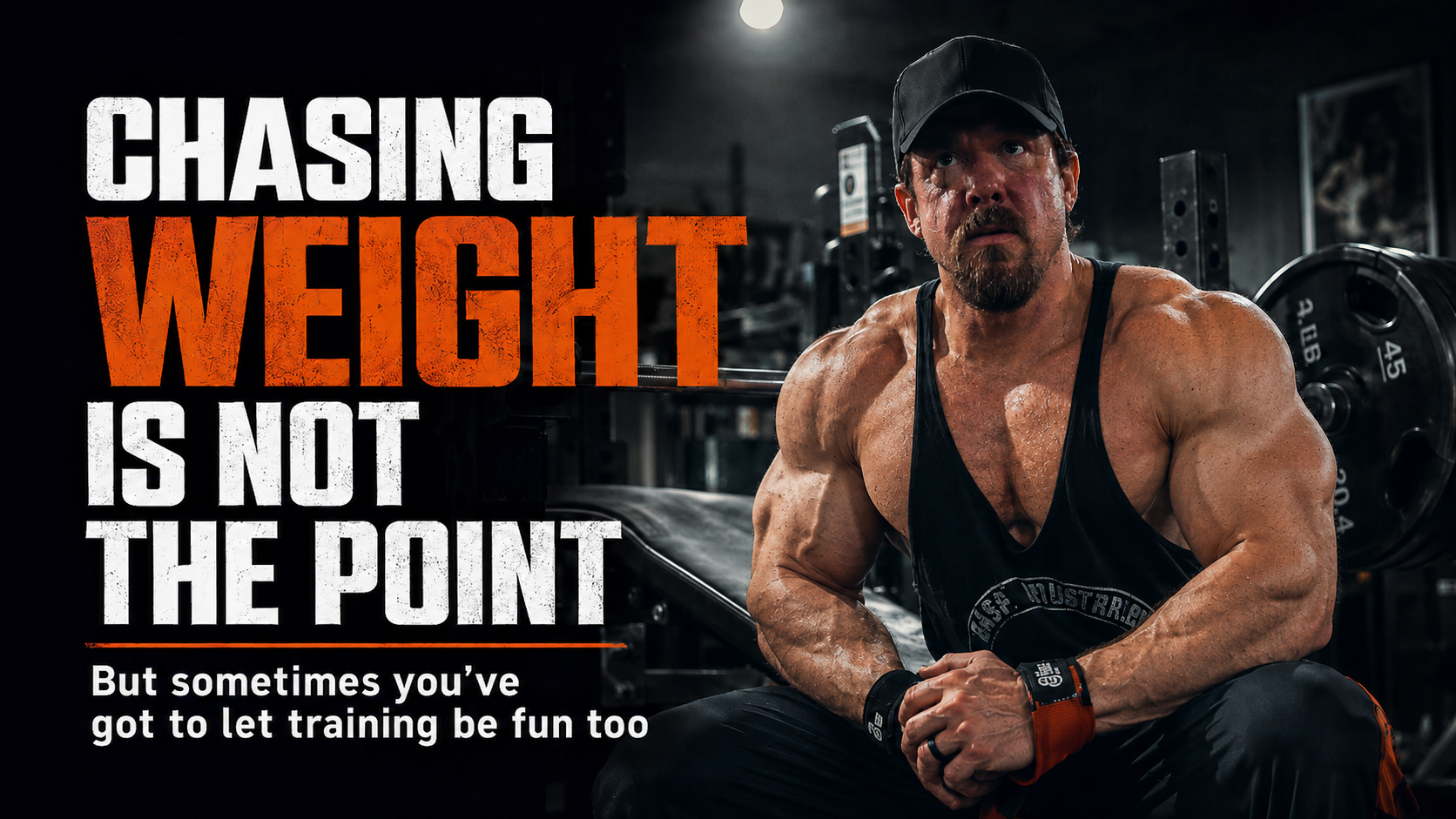
Chasing Weight Is Not the Point
I recently hit a lifetime personal best on the bench press.
That’s still a strange sentence for me to write, mostly because it wasn’t planned. It wasn’t part of some peaking phase. I wasn’t walking into the gym with the goal of testing strength. I’m honestly not the kind of person who gets too caught up in chasing numbers just for the sake of chasing numbers.
Most of the time, I care more about the quality of the work. Is the muscle doing what I want it to do? Are the reps controlled? Am I progressing in a way that actually supports the goal? Can I recover from this and come back ready to train again?
That’s where my head usually is.
But every now and then, training gives you one of those days where things just feel different.
I had decided to barbell bench press as part of my normal routine that day. Nothing special. Nothing dramatic. Just one of the movements I chose to work through. I started with the bar like I usually would, just to feel out the joints and muscles and see how everything was moving.
That part matters more now than it used to.
I’m not interested in throwing plates on the bar cold just to prove something. I want to know what my shoulders are saying. I want to know how the elbows feel. I want to feel the bar path, the setup, the tightness, and whether the movement feels like something worth pushing that day.
The bar felt good.
So I went to 135 for 12.
Still felt good.
Then 185 for 10.
Still moving easily.
Then 225 for 8.
Normally, I probably don’t go much higher than that. Not because I’m afraid of heavy weight, but because heavy weight is not always the best tool for what I’m trying to accomplish. A hard set at a moderate load with better control, better tension, and less joint cost usually makes more sense than throwing more weight on the bar just because I can.
But that day was different.
Everything was moving well. My joints felt good. The setup felt right. The weight felt lighter than expected. And honestly, I felt like my failure point at 225 was probably somewhere north of 20 reps if I really wanted to find out. If you know me, you know that I prefer failure around 12 to 15 reps.
So I added weight.
I went to 275.
I hit it for 6 reps and racked it with what was probably still 5 reps in reserve.
That’s when I knew the weight was there.
At that point, I had a choice. I could stay with the plan, keep everything conservative, and move on. That would have been fine. There would have been nothing wrong with that.
But I also hadn’t touched 315 on bench in probably 20 years.
So I grabbed a guy to spot me, got set up, unracked it, and hit 315 for an easy 3.
Honestly, I probably had 5.
But I didn’t take it there, and that’s the part I think matters. The lesson is not, “Go chase heavy weight whenever you feel good.” That’s how people get hurt.
The lesson is also not, “Never test yourself.” That’s how training starts to feel like a chore.
The real lesson is that you have to learn how to read the day in front of you.
Some days are not the days to push. The warm-ups feel wrong. The joints complain. The bar speed is slow. Your setup feels off. Your energy is flat. You’re forcing something that isn’t there.
On those days, the smart move is usually to adjust.
But there are also days where the opposite happens. The movement feels clean. The weight moves well. Your body is giving you positive feedback. You’re not forcing the issue. The opportunity just shows up.
That’s what happened here.
I didn’t walk in chasing a number. The number showed up because the work had already been done. That’s a different thing.
That’s why I think it’s important not to confuse testing strength with building strength. Most of your training should build. Most of your training should be repeatable. Most of your training should support the bigger goal instead of just feeding your ego for one session.
But sometimes, when the conditions are right, it’s okay to have a little fun with it. That’s something I think we can lose sight of as we get older.
We start becoming so focused on being careful, structured, responsible, and recovery-aware that training can become almost too clinical. Everything becomes about risk management. Every decision gets filtered through the lens of what might go wrong.
And to be fair, some of that is necessary.
At 40 and beyond, you can’t train like a reckless idiot and expect your body to keep forgiving you. The joints have mileage. Recovery has limits. Old injuries are always somewhere in the background. One bad decision can create problems that hang around longer than they used to.
So yes, caution matters.
But caution should not remove all the life from training.
There is still something valuable about feeling strong. There is still something valuable about touching a weight you haven’t touched in years and realizing you’re not done. There is still something valuable about having a day where the work shows up in a way you can actually feel.
That does something for you. Not just physically, but mentally. When you’ve spent enough years being told that your prime is behind you, moments like that push back against the story.
They remind you that the work is still working. They remind you that strength can still be built. They remind you that you’re not just maintaining, not just slowing the decline, not just trying to look decent for your age.
You’re still capable of doing things that surprise you.
That matters.
But it has to be earned the right way.
The reason I could take that opportunity is because I didn’t force it. I warmed up properly. I paid attention to how things felt. I didn’t ignore my joints. I didn’t jump from the bar to something stupid. I let the session tell me what was there.
And when I got to 315, I still didn’t turn my brain off.
I could have chased 5 reps. I probably had it. But I also knew there was no real reason to find out that day. Three clean reps gave me the win. It told me what I needed to know. It let me have the moment without turning it into a bad decision.
That’s the balance I care about now. Train hard, but don’t train stupid. Push when it makes sense, but don’t force it when it doesn’t. Enjoy the occasional big day, but don’t build your entire identity around chasing numbers.
Chasing weight is not the point.
The point is building a body that keeps getting stronger, more capable, and more durable over time, but every now and then, when everything feels right and the weight is moving better than expected, it’s okay to let yourself enjoy it.
Sometimes you’ve got to have a little fun with what you’re doing.
— Rob
Coach
Iron After 40