
Tools, Not Crutches
I’m not against using training accessories.
Wrist straps, belts, knee sleeves, elbow sleeves, wraps, lifting shoes, specialty bars, grips, attachments, machines — all of it can have a place. Used correctly, those things can help you train harder, train around issues, protect joints, improve execution, and get more out of the movement you’re actually trying to perform.
The problem is not the tool.
The problem is when the tool becomes a crutch.
That line matters, especially as you get older and you start looking for ways to keep training hard without beating yourself up more than necessary.
Take wrist straps as an example. If I’m training back, I have no issue using straps when they make sense. On heavy rows, pulldowns, RDLs, rack pulls, or any movement where the goal is to train the back, I don’t necessarily want grip to be the reason the set ends. If my lats, traps, upper back, or hamstrings still have more to give, but my hands are the limiting factor, straps can be a smart tool.
In that case, the straps are helping me train the target muscle better.
That’s useful.
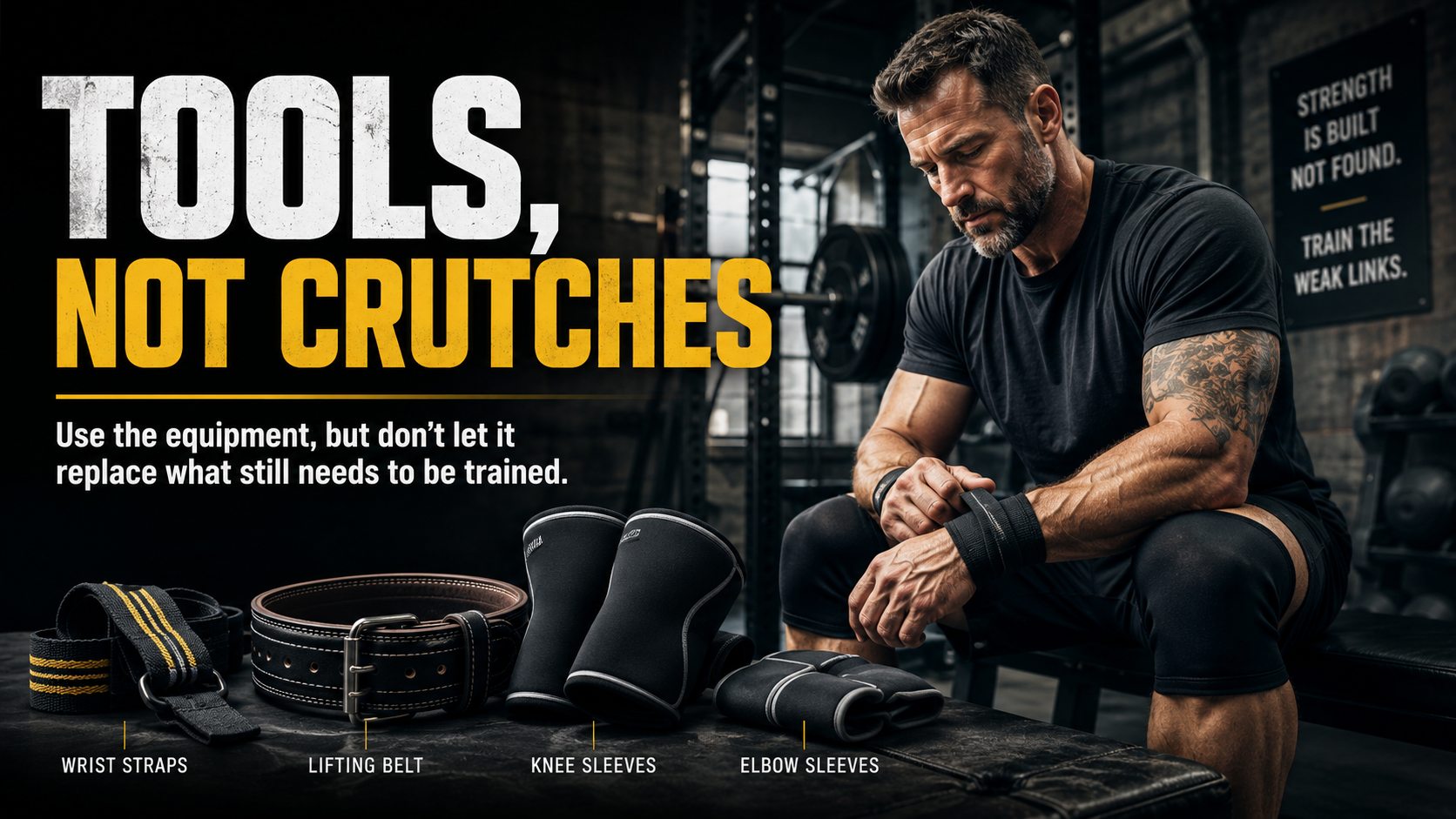
But if every pulling movement, every warm-up set, every moderate set, and every back day automatically requires straps, now it’s worth asking a different question.
Am I using them because they help the target muscle get more work?
Or am I using them because I’ve stopped allowing my grip to be trained at all?
That’s where a tool starts becoming a crutch.
Grip still matters. Forearms still matter. Holding onto weight still matters. Not every set has to become a grip test, but if you never let your grip deal with any meaningful stress, it’s probably not going to stay as strong as you want it to be.
That’s the balance.
Use straps when grip would limit the muscle you’re trying to train. But don’t use straps so automatically that your grip never has to show up.
The same idea applies to belts.
A weightlifting belt can be a great tool. For heavier squats, deadlifts, rows, or pressing movements where bracing is a major part of the lift, a belt can help you create more pressure, stay tighter, and move weight more safely and efficiently.
I’m not one of those people who thinks using a belt means you’re weak or cheating.
That’s nonsense.
But I do think there’s a difference between using a belt because the load justifies it and needing a belt because you don’t trust yourself to brace without one.
If you throw a belt on for every single set before the weight is even remotely challenging, you may be avoiding something that still needs to be trained. Your ability to brace, control your trunk, and create stability without outside support still matters.
Especially after 40.
Because the goal is not just to move weight in the gym. The goal is to remain capable. Strong. Stable. Durable. Able to produce force and control your body without needing every possible support system just to feel safe.
Again, that doesn’t mean never use the belt.
It means use it intentionally.
Maybe your lighter sets are beltless. Maybe your warm-ups are beltless. Maybe your top working sets get the belt when the load actually calls for it. That way you still practice bracing on your own, but you also use the tool when it helps you push heavier work safely.
Knee sleeves are another good example.
I like knee sleeves. They can keep the joint warm. They can make leg training feel more comfortable. They can give a little support and confidence on squats, leg presses, hack squats, and other lower body movements. For someone with beat-up knees, they can be the difference between training legs consistently and avoiding leg work because everything feels irritated.
That’s a good use of the tool.
But if the sleeves go on before you even know whether you need them, and they stay on for everything from warm-ups to extensions to calves, it may be worth stepping back and asking whether they’re helping or hiding something.
Sometimes the knees need warmth and support.
Sometimes the body also needs to be exposed to controlled loading without being wrapped up from the first rep.
There’s a difference between supporting a joint and teaching yourself that the joint can’t handle anything without help.
That may sound like a small distinction, but it’s not.
Because over time, the things you avoid training have a way of becoming weaker, less confident, or less resilient.
That’s not what we want.
After 40, I think a lot of us naturally become more protective of our bodies. That makes sense. We’ve got old injuries. We’ve got joints that complain. We’ve got mileage. We’ve got responsibilities outside the gym that don’t care whether our elbow is acting up or our low back is irritated.
So yes, we should train smarter. We should use the tools available to us. We should make adjustments that keep us in the game.
But smarter training does not mean removing every possible challenge from the body.
It means choosing the right challenge.
That’s the key.
If straps allow your back to become the limiting factor instead of your grip, use them.
If a belt helps you brace harder on heavy work, use it.
If knee sleeves keep your knees warm and let you train legs with better confidence, use them.
If elbow sleeves help you press without feeling like your joints are fighting you, use them.
But don’t let those tools replace capacities you still need.
Grip still needs stress.
Bracing still needs practice.
Joints still need controlled loading.
Tendons still need gradual exposure.
Your body still needs to learn how to produce and control force without being completely dependent on outside support.
That’s where maturity comes in.
The older I get, the less interested I am in proving how tough I am by refusing to use useful tools. That’s not smart either. There’s nothing impressive about making an exercise worse just because you want to say you did it raw.
At the same time, I don’t want to become so dependent on equipment that I can’t train confidently without it.
There’s a middle ground.
That middle ground is intentional use.
You can use straps on your hardest back sets, but still do some work without them.
You can use a belt on heavy compounds, but still practice bracing beltless.
You can use sleeves when they help, but still pay attention to how the joint actually feels without them.
You can use machines, attachments, and specialty equipment, but still make sure you’re not avoiding basic strength, stability, and control.
That’s the point.
Accessories should help you train better.
They should not become the reason you stop training certain abilities altogether.
A good tool improves the work.
A crutch replaces the work.
That’s the difference.
And it’s worth paying attention to, because a lot of lifters don’t realize when the shift happens. At first, the accessory helps. Then it becomes habit. Then it becomes automatic. Then, eventually, they don’t feel like they can train without it.
That’s usually the sign that it’s time to reassess.
Not throw everything away.
Not stop using useful equipment.
Just reassess.
Ask yourself a simple question:
Is this helping me train the target better, or is it letting me avoid something I still need to build?
That question will tell you a lot.
Because the goal after 40 is not to be reckless. It’s not to train like you have brand new joints and unlimited recovery. But it’s also not to become fragile.
The goal is to stay strong, capable, and durable for as long as possible.
Use the tools.
Just don’t let them do all the work for you.
— Rob
Coach
Iron After 40